These days, John Friesz finds his happiness tramping around the woods and steams of his pastoral home town of Coeur d’Alene, Idaho.
Though only a couple hours north from where Friesz forged his athletic reputation in Moscow, Idaho, the world of the 47-year-old former quarterback is completely different from the one who rewrote the University of Idaho record book and ranks third on the Big Sky Conference’s list of “50 Greatest Male Athletes.’’
Friesz would rather hunt and fish with his father and cheer on the athletic exploits of his three boys.
Far away from the high life of a collegiate big man on campus, John Friesz is a contented man.
“Fortunately, football bought me time and freedom,” said Friesz, who, in the late 1980s, helped bring the Vandals to the heights of the then I-AA football world. “I think, probably, some people know I played the game. I don’t care about it anymore, and I say that in a good way.
“It’s a boring story.”
And somewhat surreal, especially when Friesz looks at his name permanently and the No. 17 hanging in honor inside the dome he called home between 1985 and 1989.
It is really unbelievable to Friesz that his school’s Most Valuable Player award bears his name.
“They remind me how much fun I had in that time of my life,” said Friesz, who also spent nearly a dozen years in the NFL. “It doesn’t seem real. My success at Idaho and at the pro game doesn’t seem real.”
Real, however, it was.
Recruited out of CDA High School, Friesz redshirted his freshman season as Idaho won the Big Sky Conference under coach Dennis Erickson.
Friesz took over the next year, and when it was all done, the 6-foot-4, 220-pound quarterback would leave Idaho as the three-time Big Sky Player of the Year and holder of the Walter Payton Award.
Eventually, “Deep” Friesz would be elected to the College Football Hall of Fame.
“You could see it in him,” Erickson said of Friesz, who, from the 9th grade on, would show up, one of a 1,000 kids, at Erickson’s summer football camps.
“We just liked him from the very beginning. He had the physical tools and was very tall for his age and he had a great arm,” Erickson said. “We thought he could be a big-time player.”
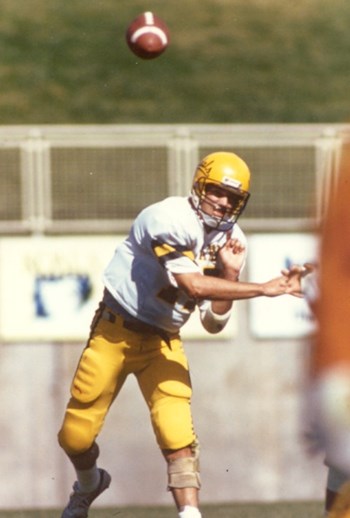
What Erickson really liked was how quickly and accurately Friesz delivered the football.
“He also knew where he wanted to go with it,” said Erickson, who left Idaho following the 1985 season.
Keith Gilbertson took over for Erickson the following season and the Vandals didn’t miss a beat.
Neither did Friesz, who would end his career at Idaho with a completion percentage at better than 59 percent (801 of 1,350).
Friesz set records for consecutive 300-yard passing games (10). He threw for more than 400 yards six times and finished his career with an average of 305.6 yards a game, or 10,697 yards.
In 1989, now under coach John L. Smith, Friesz threw for 4,041 yards and teamed with receiver Lee Allen for a record 98-yard touchdown pass. Also that year, Freisz threw 31 touchdowns and guided the Vandals to their third consecutive conference championship.
Along the way, Idaho went undefeated in conference play (8-0) for the only time in school history.
However, even the most successful story has its one regret, and for Friesz, that the lack of a I-AA championship trophy.
“That’s probably the one thing I wish could have been different,” he said. “I had an average year my junior year, but we had a good team. But I was hurt in the playoffs and my backup was hurt, too.”
Yet, that regret is only a minor irritation.
In 1989, winning came easy to Friesz and the Vandals, who featured a dynamic offensive line which often allowed their quarterback all the time in the world to survey the field.
“A quarterback can look pretty good with no pressure,” he said.
The following season, Friesz was a sixth-round draft pick of the San Diego Chargers. Knee injuries, among other ailments, prevented Friesz from reaching his full potential.
Yet, Friesz still threw more touchdowns than interceptions, 45 to 42, and finished with nearly 9,000 career yards from the Chargers, Washington, Seattle and New England.
“You can’t do anything about [injuries],” Freisz said. “I can’t complain. I’m a guy who didn’t start my junior year in high school.”
All of which is why Friesz can afford to live the easy life in Coeur d’Alene, working with several charities and trying to be part of the community.
“My family kept me grounded,” Freisz says of his father and mother, Mel and Mary Jo. “I’ve always despised arrogance and I try not to be that way. I try to feel like I did the right thing that day.”
Back in the day, Friesz was always in the moment. Now, as he reflects on how it all went, “I’m happy.”
