The following story was written by Weber State Media Relations Director Paul Grua for an upcoming book commemorating 50 years of Weber State men's basketball. The book will be available later this fall through Weber State's Wildcat Club. The 1968-69 Weber State Wildcats earned the Big Sky Conference’s first victory in the NCAA Men’s Basketball Tournament. The victory over Seattle ranks 21st on the Big Sky Conference’s List of “50 Greatest Men’s Moments.’’
At the start of the 1968-69 season Weber State was entering its sixth season as a Division I school but was facing its first coaching change. Dick Motta left Weber State after the 1967-68 season to become the head coach of the Chicago Bulls in the NBA. He led the Wildcats to three Big Sky titles in the five years he coached in the Big Sky.
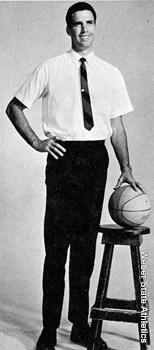
But Motta’s departure didn’t leave Weber State empty handed. He was replaced by a young first-time head coach who had spent the previous four years as an assistant under Motta. Phil Johnson was named the head coach at Weber State in the summer of 1968 at the age of 27. Johnson was a former basketball play at Weber and Utah State.
The 1968-69 Wildcat roster included five returning letterwinners, four of whom were seniors. Among the returners was Justus Thigpen, a senior guard from Flint, Michigan who was the leading scorer on the previous year’s team that had advanced to the NCAA Tournament. Joining Thigpen on that squad was Larry Bergh, a 6-7 forward from Walla Walla, Wash., who was a two-year veteran and the team captain that season. Gus Chatmon, Gary Strong and Richard Nielsen also returned from a 1967-68 team that finished 21-6 overall.
The new group was highlighted by a 6-8 sophomore named Willie Sojourner who came to Weber State from Germantown, Penn. On the freshman team Sojourner averaged 21.3 points and 14.4 rebounds per game and many were excited to see what he would do on the varsity level. He was tabbed as the finest freshman to ever enroll at Weber. Another newcomer was junior college transfer Sessions Harlan who came to Weber from Iowa Central Junior College.
The Wildcats opened the season on a sour note, falling 89-77 at West Texas State in the season opener. That would be the only time Johnson would ever have a losing record in his career at Weber State. The team returned home to the Swenson Gym and started winning. They went on to win 26 of their next 27 games.
The Wildcats won 12 straight games before falling 100-62 at Seattle. They then won their next 14 games. The team was rolling through the Big Sky Conference as well. They had another 12-game winning streak heading into the final Big Sky game of the year, March 3 at Montana State, looking to finish league play undefeated. Even though the team had already clinched the league title they went out and defeated Montana State 86-84 behind 27 points and 17 rebounds from Sojourner and 22 points from Thigpen and the Wildcats finished league play 15-0. They won all 15 Big Sky games by an average of 15.3 points per game. That time is one of just two teams to ever finish a regular season undefeated in Big Sky play.
There was no conference tournament at the time and the Wildcats received an automatic spot into the NCAA Tournament. They were assigned to once again face Seattle in the first round in Las Cruses, New Mexico, the same Seattle team they had already played twice. Weber beat the Chieftains at home, but lost 100-62 two months earlier. That was Weber’s last loss at the time, heading into the NCAA First Round with a 13-game winning streak. However, just getting to Las Cruses for the game proved to be a challenge for the Wildcats.
“On the trip to Las Cruses we chartered a plane and the plane lost an engine on the way there,” Johnson recalled. “I always sat in the back and went to sleep and I didn’t really know too much about it. Then all of the sudden the players were very upset and worried. There were four prop engines and one of them quit. I told the team if we win this game we will charter a jet on the next trip. They probably played a little harder because of that. We landed in a wind storm in Las Cruses without one engine and it was pretty scary.”
“We weren’t in the air very long and one of the boosters that was behind me said the engine cut off,” Thigpen remembered. “We saw smoke coming out of the plane and the blades had stopped and the plane was going sideways. When we got off the plane we kissed the ground.”
Once they arrived at the game, the Wildcats made the most of it and defeated the Chieftans 75-73 behind 22 points and 10 rebounds from Willie Sojourner, one of four Wildcats in double figures. Bergh, Harlan and Thigpen all scored in double figures. Weber State shot 52 percent from the field and held Seattle to 39 percent shooting.
The win was a significant milestone, marking the first victory ever by a Big Sky team in an NCAA Tournament. It was the first of six NCAA Tournament victories by Weber State in the NCAA Tournament.
With the win the Wildcats advanced to the NCAA West Regionals in Los Angeles to face a Santa Clara team that was ranked second in the country. Santa Clara jumped out to a 27-9 lead and led 29-19 at halftime but Weber came back and had a chance to win. The score was tied 55-55 with six seconds left when the ‘Cats missed two free throws. The game went into overtime where Weber State fell 63-59. Had the Wildcats won that game they would have faced eventual champions UCLA coached by John Wooden with Lew Alcindor as a senior on that squad.
Weber State didn’t face the top-ranked Bruins and instead met New Mexico State in the consolation game at the West Regionals, the same team they had lost to the previous year in their first trip to the NCAA Tournament. The Aggies had basically the same team coming back and jumped out to an early lead but the Wildcats were able to come back and win 58-56 to finish the year 27-3, the best winning percentage in school history.
In his first season as head coach Phil Johnson was named Big Sky Coach of the Year after leading Weber State to the 27-3 mark. He went on to coach the Wildcats two more seasons, finishing 20-7 in 1969-70 and 21-6 in 1970-71. All total Johnson was 68-16 in his three seasons at Weber State, the best winning percentage in Big Sky history. He led the Wildcats to three Big Sky Championships and three trips to the NCAA Tournament and was named Big Sky Coach of the Year all three seasons.
During the 1968-69 season four Wildcats earned Big Sky All-Conference honors with three of them named to the first team. Willie Sojourner finished the year averaging 18.8 points and 13.0 rebounds per game while shooting 51.5 percent from the field. He was named First Team All-Big Sky for his performance and would go on to become one of the best players in Weber State and Big Sky history. Sojourner currently ranks fifth in Weber State history in career scoring with 1,563 points and is still the Big Sky’s career leader in rebounding average at 14.1 per game. He is Weber State’s career leader in total rebounds and ranks second in Big Sky history with 1,143 rebounds.
For the second-straight season Justus Thigpen was named to the All-Conference first team. He averaged 18.6 points and shot 53.4 percent from the field as a senior. He was drafted in the 11th round of the 1969 NBA Draft by the San Diego Rockets. He instead played his first year as a professional for the Pittsburgh Pipers of the ABA. In the 1972-73 season he played in 18 games for the Detroit Pistons of the NBA and then played in one game in the 1973-74 season for the Kansas City-Omaha Kings where Phil Johnson was an assistant coach.
Sessions Harlan, who had transferred to Weber State as a junior college player that season, also earned first team All-Conference honors. He averaged 13.4 points per game that season and went on to repeat with first team honors again in 1969-70. Sojourner, Thigpen and Harlan were all named to the Weber State 50th Anniversary Men’s Basketball Team.
Gus Chatmon also earned All-Conference honors that season as he was named to the second team. Chatmon finished the year averaging 6.6 points and 8.9 rebounds per game. Larry Bergh posted 9.2 points and 6.5 rebounds per game.
